
Make science fun with the How Do Sound Waves Travel Kids Worksheet; printable, standards-aligned, and hands-on. Boost engagement with visuals and an answer key. A kids’ worksheet shows how sound waves move as vibrations through matter. If you teach science to young learners, you know visuals and hands-on tasks make ideas stick.
This guide walks you through creating a clear, fun, and accurate How Do Sound Waves Travel Kids Worksheet. You will get ready-to-use sections, classroom-tested activities, and tips to boost learning and delight curious minds.
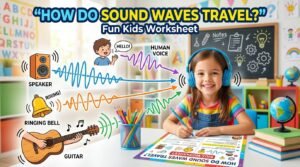
What Is Sound?
Sound is a vibration. It starts when something moves back and forth. That vibration pushes nearby particles. Those particles bump the next ones, and the next, carrying energy.
Key points to teach kids:
- Sound needs a medium like air, water, or a solid.
- In space, there is no air, so no sound.
- Sound moves as a wave of compressions and rarefactions.
Teacher tip from my own classes: I tap a drum, then place a hand on the skin. Students feel the vibration and hear the beat. That simple moment sets up the How Do Sound Waves Travel Kids Worksheet with real meaning.

How Sound Waves Travel Through Different Materials
Sound is a longitudinal wave. That means particles move back and forth in the same line as the wave. Picture tiny push-and-pull zones. Compressions bunch up. Rarefactions spread out.
Speed depends on the medium:
- Air at room temperature: about 343 meters per second.
- Water: about 1,480 meters per second.
- Steel: about 5,000 meters per second.
Why the change? In solids, particles are close and linked. Vibrations jump faster. In water, they are closer than in air, so sound speeds up. In air, particles are far apart, so sound is slower. Add a simple chart of fast, faster, fastest to your How Do Sound Waves Travel Kids Worksheet? Students love ranking tasks.

Why Air, Water, and Solids Feel Different
Try this analogy. Air is like a loose crowd. It takes time for a message to pass. Water is a tight line. The message passes quicker. Steel is a locked arm chain. The message flies down the line. That story helps kids remember how sound waves travel.
Core Concepts Your How Do Sound Waves Travel Kids Worksheet Should Cover
Focus on a few big ideas with clear words and neat sketches:
- Vibration: a back-and-forth motion that starts sound.
- Medium: the stuff sound travels through, like air or water.
- Wave parts: compression and rarefaction.
- Pitch: how high or low a sound is. It links to frequency.
- Volume: how loud or soft a sound is. It links to amplitude.
- Speed of sound: faster in solids, slower in gases.
- Echo: sound that reflects from a surface.
- Vacuum: no particles, so no sound.
Add small, simple lines next to each term. Example: Pitch is like squeak vs. roar. Volume is whisper vs. shout. Keep it friendly, yet correct. This blend supports a strong How Do Sound Waves Travel Kids Worksheet that meets standards and keeps kids engaged.

Build the How Do Sound Waves Travel Kids Worksheet Step by Step
Step 1: Set clear goals
- Students can define vibration and medium.
- Students can label compression and rarefaction on a drawing.
- Students can sort materials by sound speed.
Step 2: Add a quick warm-up
- Circle the objects that vibrate: guitar string, glass of water, shoe.
- True or false: Sound can travel in space.
Step 3: Include a core diagram
- Show a spring-like line with tight and loose parts.
- Ask students to color compressions red and rarefactions blue.
- Prompt: Label the direction the wave moves.
Step 4: Use short prompts
- Fill in the blank: Sound is a ______ that moves through a ______.
- Match: pitch, volume, amplitude, frequency to simple meanings.
Step 5: Real-world link
- Why can you hear a train on the track by touching the rail?
- Why do whales hear each other far away in the ocean?
Step 6: Quick practice math
- If sound is faster in water than air, which arrives first to a diver, a voice in air or a tap on a metal tank in water?
Step 7: Reflection
- Write one thing you felt, heard, or saw in today’s demo.
Step 8: Answer key notes for you
- Include a small teacher key with one-line rationales.
- Add hints like use words like push, pull, and bounce for compressions and rarefactions.
With these parts, your How Do Sound Waves Travel Kids Worksheet? will be both simple and deep.
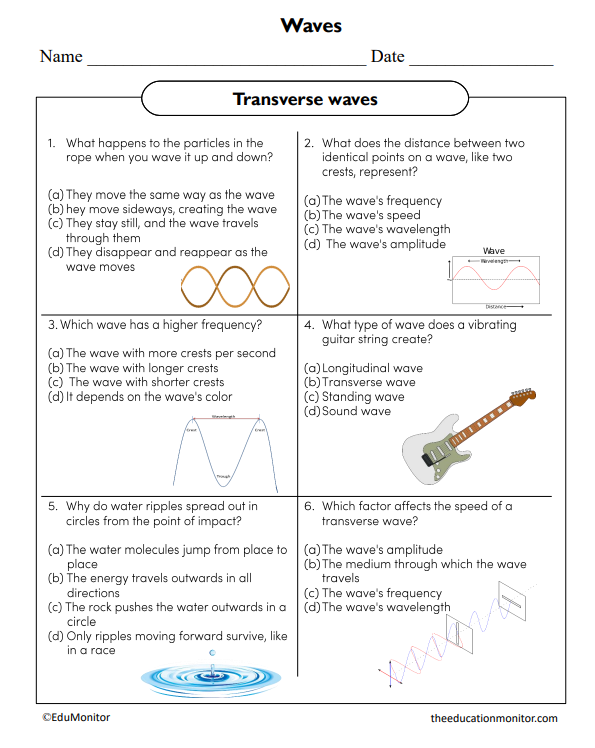
Hands-On Activities That Pair With the Worksheet
Use quick, low-cost stations so kids connect ideas to action:
- Rubber band guitar: Stretch a band over a box. Pluck soft and hard. Ask which changes volume and pitch.
- Ruler buzz: Hang a ruler off a desk. Flick it. A shorter hang gives a higher pitch. Longer hang gives lower pitch.
- Slinky demo: Push and pull to show compressions and rarefactions. Students sketch what they see on the How Do Sound Waves Travel Kids Worksheet?.
- Cup-and-string phone: Use two cups and a tight string. Whisper a word. Ask kids which medium carries sound here.
- Tuning fork and water: Tap a fork and touch water. See ripples. Talk about energy moving through a medium.
- Plastic wrap drum: Stretch wrap over a bowl. Sprinkle rice. Play a low and a high note. Watch the rice jump.
Safety notes I use every time:
- Keep volume safe. No shouting near ears. Aim for short bursts of sound.
- Mind fingers and eyes around tight strings and metal forks.
- Clear rules. One voice in the room while testing. Then rotate.
Tie each station to a quick box on the How Do Sound Waves Travel Kids Worksheet for data, a sketch, and one idea.

Assessment, Differentiation, and Standards Alignment
Use a simple rubric:
- Beginning: can name sound as a vibration.
- Developing: can show compressions and rarefactions in a drawing.
- Proficient: can explain how sound needs a medium and compare air vs. water.
- Advanced: can apply ideas to a new case, like sonar or stethoscopes.
Differentiation ideas:
- Provide word banks for new readers.
- Offer sentence starters like Sound travels fastest in ____ because ____.
- Add challenge tasks: Predict what happens on Mars with thin air.
Standards tie-in:
- Waves and information transfer ideas for early grades.
- Structure, function, and simple models.
- Observation, measurement, and cause-effect language.
Add these notes to your teacher copy of the How Do Sound Waves Travel Kids Worksheet so it supports every learner.
Common Mistakes and How to Avoid Them
Help students shift from myths to facts:
- Mistake: Sound can move in space. Fix: No air, no sound.
- Mistake: Loud means high pitch. Fix: Loud is amplitude. Pitch is frequency.
- Mistake: Ears are the only way to sense sound. Fix: You can feel strong vibrations in your skin or chest.
- Mistake: Sound is faster in air than water. Fix: It is faster in water and fastest in most solids.
- Mistake: Echoes only happen in caves. Fix: Any hard surface can reflect sound.
Place a small true or false quiz in the How Do Sound Waves Travel Kids Worksheet to check these.
Print-Ready Sections for Your How Do Sound Waves Travel Kids Worksheet
Use this template to build a clean, one-page sheet:
- Warm-up: two quick questions that spark talk.
- Read and label: one picture of a longitudinal wave.
- Try it: a short demo box with steps and safety.
- Observe: a space to draw and note what they see or feel.
- Apply: two real-world cases to compare.
- Reflect: One sentence that starts with I noticed, or I wonder.
- Exit ticket: Define medium in your own words.
Make an answer key with plain, short lines. Add one common wrong idea and a fix note. This helps you give fast, kind feedback. Repeat the focus term in headers to boost clarity: How Do Sound Waves Travel Kids Worksheet? Note Set, How Do Sound Waves Travel Kids Worksheet? Apply Box, and so on.
Frequently Asked Questions of How Do Sound Waves Travel Kids Worksheet?
What age group is best for this worksheet?
Grades 2 to 5 work well. Adjust reading level, pictures, and activity time to match your class.
How long does the lesson take?
A full lesson fits in 30 to 45 minutes. Hands-on stations can extend it to one hour.
Do I need special tools?
No. Use classroom items like rubber bands, cups, string, and a slinky. A tuning fork helps but is optional.
Can this work for remote learning?
Yes. Use short videos, simple home items, and a digital version of the How Do Sound Waves Travel Kids Worksheet?. Add clear pictures and large labels.
How do I check understanding fast?
Use the exit ticket. Ask students to label a wave and name a medium in two lines.
Conclusion
Sound becomes simple when kids can see it, feel it, and name it. With a thoughtful How Do Sound Waves Travel Kids Worksheet, clear models, and quick demos, you turn tough words into easy wins. Start small, keep safety tight, and build ideas step by step.
Try the template, test one hands-on station, and watch curiosity rise. Want more ready-made sheets and activities? Subscribe for updates, download the print-ready How Do Sound Waves Travel Kids Worksheet pack, or leave a comment with your classroom wins and questions.